
from: 'Homesteads: early buildings and families from Kingston to Toronto" by Margaret McBurney & Mary Byers, 1979.
photos by Hugh Robertson
The first Crown grants issued in a new settlement did not necessarily go to the families who were the first to occupy the land. Certain conditions had to be met regarding clearing the acreage before a patent could be approved. In addition, some connection with those in power was a distinct advantage. The first patents in Smith's Creek went to Captain Jonathan Walton and Elias Smith in 1797. They received the whole site of what was later Port Hope, even though a number of settlers had been on the land since 1793. One of these was Lawrence Herkimer, brother of Nicholas Herkimer of Herkimer's Nose near Kingston; a fur trader, he had built a log house and was engaged in a successful business until he lost the land to Walton.
Elias Smith and his wife Catherine came to Upper Canada from Orange County, New York. By 1795 Elias had built a mill with the assistance of Joseph Keeler, Colborne's first settler. The Smiths were accompanied by some of their ten children, among them John David, who built The Bluestone in 1834. This magnificent building, at 21 Dorset Street East, is one of the finest examples of the classical revival style in Ontario.
John David Smith served as a captain in the War of 1812, and later as a member of the Legislative Assembly. The Bluestone was a wedding gift to his second wife, Augusta Louisa Woodward. The Smiths undoubtedly needed all the room that the spacious house afforded, for eventually there were fourteen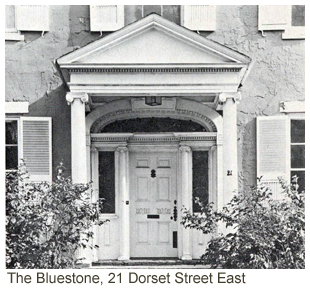 children - ten born to John David's first wife Susan, and four to Augusta Louisa. As in the Allan Macpherson house in Napanee, the front and rear facades of The Bluestone are identical. Stone for the foundation came from the nearby Ganaraska River. For the remainder, large limestone blocks were transported to the site from Kingston. Stucco now covers the stone. The house's name referred either to the colour of the limestone or to the colour of paint applied to the stucco, a shade then called stone-blue. The house is rich in architectural detailing, much more so than most built in the province at the time. Skilled craftsmen from England and the Continent were hired to carve the interior mouldings and create the ornate plaster ceilings. A cargo of Italian marble is said to have been lost in Lake Ontario on its way to Port Hope for The Bluestone's nine mantelpieces.
Elias Smith and Jonathan Walton donated the land on which St Mark's, the Anglican church on King Street, was built. Walton also donated a bell that is still in use. The church, initially called St John the Evangelist, was built in 1822. Sometime before 1851 the spire was added and other changes and additions made. A new Anglican church was built across the river in 1869 and the little white church was closed. One of the church wardens, not wanting the Walton bell to ring in any other building, buried it in a nearby field; the bell was unearthed when St Mark's re-opened four years later. Inside the church, the simplicity of the hand-hewn beams and the early box pews blends pleasantly with later additions - the altar, triptych, and chancel. Many of the town's first settlers are buried in the church cemetery. So is the first Canadian-born governor-general, Rt. Hon. Vincent Massey.
For many years the small settlement was known as Smith's Creek, not after Elias but Peter Smith, a fur trader who had a post on the east side of the creek, opposite the present town hall, as early as 1778. It was he who made the disputed sale of land to Nicholas Herkimer. When the first post office opened in 1817, an official name had to be chosen. For a while the village had been called Toronto, but this name was also set aside, to be picked up in 1834 by a growing community some sixty miles to the west. Port Hope was chosen instead.
Port Hope grew prosperous. The harbour bustled with activity. Exports of agricultural products, lumber, and internationally famous whiskey left the docks daily. During the 1830s, as many as fifty vessels docked in one week.
Captain Wallace owned a schooner, a wharf, and a lumber exporting business. The low frame building that stands at the south end of King Street is thought to have been built for him. Later it became the Seaman's Inn and later still a girls' boarding school. The third floor contains a series of small rooms which could have accommodated, successively, Wallace's nine children, lake sailors, and finally young students. The house fell into disrepair, but in recent years the ugly insulbrick facing has been removed, revealing the pleasant frame structure underneath. The Wallace home is now known as Canada House. Near it on King Street stand several modest frame houses which for many years were occupied by other lake captains.
Most of the buildings on Walton Street, Port Hope's main street, were built in the 1850s, and this partially explains the coherence of architectural styles. To maintain a horizontal roof line in spite of the
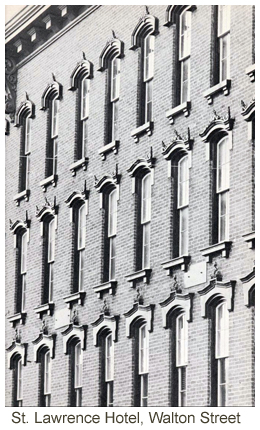 slope of the hill took some ingenuity, and sills and frames had to be adjusted at the lower levels. Many of the buildings at the west end of the street are residential, but they blend well with the commercial structures, even repeating some classical details, as in the terraced house at 134-6 Walton Street. Perhaps the finest building on the street is the St Lawrence Hotel with its Italianate facade.
Two of Walton Street's early buildings, although of little architectural interest, were involved in the career of one of Port Hope's most remarkable citizens - William Hunt, later known as Signor Gilnor Gilarma Farini or 'Farini the Great.' He was one of the most amazing men produced in Canada during the last century, and it is surprising that so little is known of him today.
William Hunt was born in Lockport, New York, but his family moved to Bowmanville and then to Port Hope when he was a small child. He studied medicine for a short time, until one day he saw a tightrope act at a visiting circus. Hunt was captivated and practised the art. He made his first public appearance in Port Hope in 1859. Two years later, after spectacular feats elsewhere, he returned to his home town to walk - with peach baskets on his feet - on a rope stretched between the Waddell Block (at the southeast corner of Walton and Mill) and the Gillett Building (at the southeast corner of Walton and Queen): there were then no buildings between these two. The stunt was a great success, but Hunt's father felt the family had been disgraced, and the young man left home.
Between these two appearances in Port Hope, he performed at Niagara Falls, and not as William Hunt but under the more theatrical name of Farini. He was about twenty years old, but repeated all the tricks of the much more famous Blondin - then at the height of popularity - even adding a few of his own. To the delight of the ever-increasing crowds, Farini climbed down to the Maid of the Miste from the centre of a slack rope strung across the gorge, then ascended to the cable again; he cooked a meal over the falls while on a rope; he walked on sixteen-foot stilts through the water at the head of the falls. Not satisfied with the title of aerialist, he dubbed himself a 'pangymnastikonaerostationist.' Up to ten thousand people flocked to see him perform, and several excursion trains carried fans from Port Hope, Colborne, and Cobourg.
Farini was not unaware of the value of publicity. In August 1860, when the Prince of Wales visited Canada and watched Blondin perform, Farini offered to take the heir apparent to the British throne across the falls in a wheelbarrow, on a tightrope, free of expense. In this way thousands may see him who would not have an opportunity if he came by railroad or any ordinary conveyance. The greatest natural phenomenon on this continent has been running over six thousand years in preparation for this event.
The prince did not take up the offer. But there is a story, often repeated, that Farini pushed his wife in a wheelbarrow on a tightrope across the Falls - and dropped her when he stopped to wave at some fans. The Niagara Falls Gazette in December 1862 reported a variation on this story of 'the death of Farini's wife due to a fall from his back at the Plaza Torres Bull Ring, in Havana, Cuba.' But Farini kept a diary for much of his life, and a search through eight volumes of his papers has turned up no evidence that he was married at this point.
Farini did marry at the age of forty-six. He chose for his bride Anna Muller, a concert pianist who was the daughter of an aide-decamp to the German Kaiser, a niece of Richard Wagner, and a former pupil of Franz Liszt. The couple had one son, Willie Leonard Farini.
During the first world war, they were detained in Germany and forced to act as interpreters. Farini wrote a history of the war that filled thirty-six notebooks. His other writings indicate the breadth of his interests and travel: they include Through the Kalahari, Ferris Which Grow in New Zealand, and articles on 'How to make Yogurt/ 'The Devil,' and 'Ladies' Hats.' Farini was also an inventor (with forty patents to his credit), a sculptor, and a painter. In 1908, his paintings were exhibited in Toronto with those of
C W Jefferys. He travelled to many parts of the world but returned to Port Hope. He died in 1929.
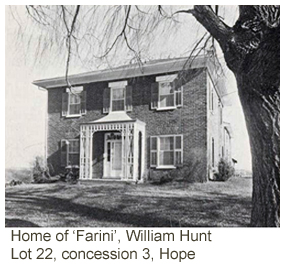
To the north of Port Hope, west of the village of Welcome, is the red brick house where William Farini Hunt grew up. It is located on lot 22, concession 3, Hope, on the first concession road north of Highway 2. In later years, Hunt purchased part of lot 21, just east of the original homestead. The small brick stable where he reputedly practised for his first aerial act is still standing at the south end of lot 22, beside Highway 2, the Danforth Road. In 1889 he made his last move, to the William Marsh farm, lot 17, concession 2, Hope.
A singular feature of Port Hope architecture is the presence of many small 'Ontario cottages' in which classical details have been finely applied in a scale appropriate to the buildings' size. The Trick house, at 254 Ridout Street, is a good example, It was built on part of a Crown grant made in 1832 to Thomas Gibbs Ridout, who held the land until the 1850s when it was subdivided and sold. Richard Trick, a mason, bought this lot in 1850 and likely built the house shortly afterwards. The main floor is several feet above grade level because the original kitchen was in the basement and required windows. The house
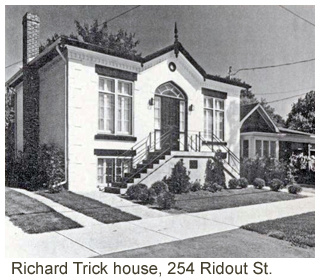 remained in the family for seventy-one years.
Dodds Directory of 1880 lists a descendant of Richard as owning the 'J Trick Planing Mill and Well Tube Factory' which was located in Barrett's Block on Cavan Street. For many years the Trick house was a store. The owner kept black walnuts in a basket on his verandah, and squirrels would get into them. Today the verandah has disappeared, but the squirrels have left a legacy - a number of splendid walnut trees.
The cottage at 284 Ridout Street shows elements of classical revival in the heavy pilasters at either end of the facade and the slightly detached fan transom. The date of construction, 1850, appears over the door. In that year the property, another part of the Ridout block, was sold to Thomas Spry, a local blacksmith. He was still living there in 1880.
remained in the family for seventy-one years.
Dodds Directory of 1880 lists a descendant of Richard as owning the 'J Trick Planing Mill and Well Tube Factory' which was located in Barrett's Block on Cavan Street. For many years the Trick house was a store. The owner kept black walnuts in a basket on his verandah, and squirrels would get into them. Today the verandah has disappeared, but the squirrels have left a legacy - a number of splendid walnut trees.
The cottage at 284 Ridout Street shows elements of classical revival in the heavy pilasters at either end of the facade and the slightly detached fan transom. The date of construction, 1850, appears over the door. In that year the property, another part of the Ridout block, was sold to Thomas Spry, a local blacksmith. He was still living there in 1880.
Thomas Gibbs Ridout, who sold both properties, had come to Upper Canada as a youth at the end of the Revolutionary War, and at the age of nineteen had been appointed deputy assistant commissary general, possibly owing to the fact that his father, Thomas Sr, was surveyor-general at the time. From 1822 to 1861 he was cashier (a position equivalent to general manager) of the Bank of Upper Canada. The Port Hope property was chiefly an investment, but nevertheless many of the town's streets were named after his family: Charles Street after his son, Julia Street after his daughter Juliana, and Dorset Street after the English county from which the Ridouts came.
Among many other 'Ontario cottages', three stand out: The Belvedere at 95 Augusta Street, 15 Julia Street, and the cottage at the end of Little Hope Street. All show much attention to detail and quality of workmanship.
Port Hope is also fortunate in possessing attractive row housing. Barrett's Terrace which joins Cavan Street and Ontario Street is one example. The builder successfully avoided monotony along the facade by imaginative use of low-relief brick work and by repetition of a lyre motif on the verandah posts. Other examples can be found throughout the town.
An architectural feature frequently seen on Port Hope buildings is a decorative trim known as 'cresting.' This ornate ironwork was a product of the Helm foundry, a firm operated by one of the town's earliest families. The foundry was located in the town centre. The family home - now the Greenwood Towers - was on the Danforth Road east of the town. It was built in 1866. A handsome water tower was built next to it nine years later. The tower has good windows, artistic wrought iron, and ornate brick work, all unusual in such a utilitarian structure.
At 44 Pine Street North, on a lot that once contained over one hundred pine trees, stands a house with the appropriate name of Pinehurst. It was built in 1846 by Nesbitt Kirchhoffer, who had been practising law in Port Hope since 1840.
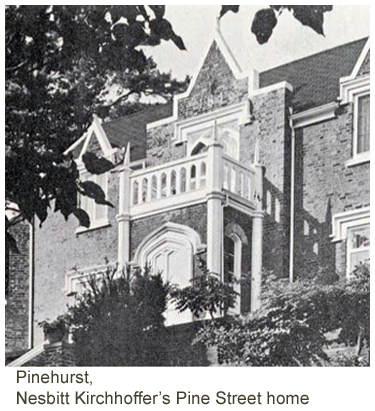 (He was an uncle of Senator John Nesbitt Kirchhoffer.) In 1890 the house was sold to a descendant of Elias Smith. The new owners' daughter recalled her mother's initial reaction to the house:
'I wouldn't have Pinehurst as a gift.' This was probably because Ada Kirchhoffer always kept the shutters closed, and the house impressed Mrs Smith as being
'a dismal, dark, and musty mansion.' Mr Smith nevertheless bought it for $5,000 over his wife's objections. In her memoirs, their daughter described Pinehurst:
It is not a spacious house but the buttresses on the corners make it appear larger than it really is. There are French windows opening into the rooms and in my time during the summers they stood open. On the ground floor we had sitting, drawing and dining rooms, these with open fireplaces. Around three sides of the house were terraces flanked by brick walls with stone steps leading down to lower lawns. We had a coal furnace with no pipe leading upstairs, so Mother had a small box-stove named Black Beauty in her bedroom and around which on chilly mornings we made our toilet. In the kitchen was a force pump and in the unfinished attic, a storage tank. The pump had to be serviced by hand and it required 50 hearty strokes to raise the water 1 inch. Here our
'boy friends' worked many a week for their Sunday supper after church.
From the west end of Ridout Street and south to Lake Ontario once lay the property of the Williams family. Here in 1828 John Tucker Williams built his home and called it Penryn, after his ancestral home in Cornwall.
Williams served under Lord Nelson and came to Canada during the War of 1812. He took part in that war and later commanded the Durham Regiment during the Rebellion of 1837. From 1841 to 1848 he sat as a Member of Parliament. Political campaigns in those days were never dull. Williams' opponent in the election of 1843 was George Strange Boulton of Cobourg. The followers of both resorted to rioting. One man was killed during one of many clashes between the two factions. Because of the difficulty of travel, voting stretched over six days, and on the last day, with Williams ahead, the opposition threatened to tear down the polling booth and remove the poll-books. Williams won, however.
His son, Arthur T. Williams, built an impressive home just to the west of Penryn when he married Emily Seymour.
(He was an uncle of Senator John Nesbitt Kirchhoffer.) In 1890 the house was sold to a descendant of Elias Smith. The new owners' daughter recalled her mother's initial reaction to the house:
'I wouldn't have Pinehurst as a gift.' This was probably because Ada Kirchhoffer always kept the shutters closed, and the house impressed Mrs Smith as being
'a dismal, dark, and musty mansion.' Mr Smith nevertheless bought it for $5,000 over his wife's objections. In her memoirs, their daughter described Pinehurst:
It is not a spacious house but the buttresses on the corners make it appear larger than it really is. There are French windows opening into the rooms and in my time during the summers they stood open. On the ground floor we had sitting, drawing and dining rooms, these with open fireplaces. Around three sides of the house were terraces flanked by brick walls with stone steps leading down to lower lawns. We had a coal furnace with no pipe leading upstairs, so Mother had a small box-stove named Black Beauty in her bedroom and around which on chilly mornings we made our toilet. In the kitchen was a force pump and in the unfinished attic, a storage tank. The pump had to be serviced by hand and it required 50 hearty strokes to raise the water 1 inch. Here our
'boy friends' worked many a week for their Sunday supper after church.
From the west end of Ridout Street and south to Lake Ontario once lay the property of the Williams family. Here in 1828 John Tucker Williams built his home and called it Penryn, after his ancestral home in Cornwall.
Williams served under Lord Nelson and came to Canada during the War of 1812. He took part in that war and later commanded the Durham Regiment during the Rebellion of 1837. From 1841 to 1848 he sat as a Member of Parliament. Political campaigns in those days were never dull. Williams' opponent in the election of 1843 was George Strange Boulton of Cobourg. The followers of both resorted to rioting. One man was killed during one of many clashes between the two factions. Because of the difficulty of travel, voting stretched over six days, and on the last day, with Williams ahead, the opposition threatened to tear down the polling booth and remove the poll-books. Williams won, however.
His son, Arthur T. Williams, built an impressive home just to the west of Penryn when he married Emily Seymour.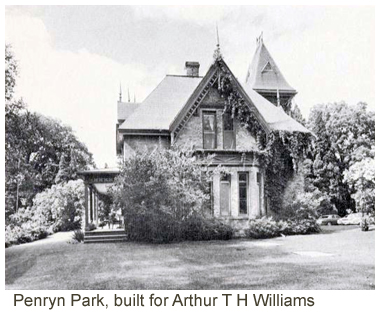 Called Penryn Park, it has recently been converted into a private club. In 1900 a billiard house was built immediately behind it. Arthur Williams was the lieutenant-colonel commanding the 46th battalion of volunteer militia sent against Louis Riel during the North West Rebellion of 1885. Port Hope was proud of him and his troops, and each man was given $100 by Mayor Ward 'for the purchase of extra underwear and other equipment.' Williams - the 'hero of Batoche' - led his battalion to victory, an event which was re-enacted at home by jubilant townspeople, some dressed as Indians and Metis rebels. But soon after the battle, still in the North West, Colonel Williams died. His triumphal return became a funeral procession with fifteen thousand people in attendance. A statue of him in front of the town hall was unveiled in 1889 by Sir John A. Macdonald.
During his visit on that occasion to Port Hope, the prime minister spent the night at the home of
H A Ward, Member of Parliament for East Durham. He also visited Dunain (from the Gaelic Dun-cwm, 'Hill of the Birds'). This imposing house, at 345 Lakeshore Road, belonged to William Fraser, whose family home near the River Ness in Scotland inspired its name. The land on which it was built was part of the Williams property and the house was a gift from her brother to Augusta Williams when she married Fraser in 1857. Fraser had come to Port Hope eleven years earlier as the representative of a group of Montreal merchants, and had since become manager of the Commercial Bank at Cavan and Walton Streets.
Augusta Fraser was a talented singer and a noted beauty. Married at the age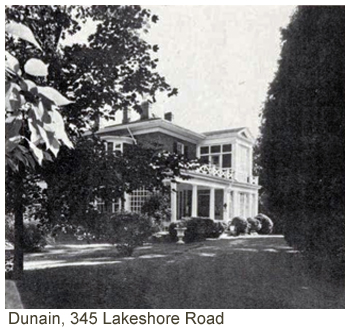 of twenty, she had borne five children by the time she was twenty-five. It did not seem to affect her looks. In 1860 she attended a ball in Montreal in honour of the Prince of Wales, and danced with the future king after he asked - according to family history-to meet 'the young lady with the lovely arms and neck.' One of her daughters married Frederic Barlow Cumberland, who became general manager of the Niagara Steamship Lines. Over the front door at Dunain is a stained glass window that came originally from the captain's cabin on the steamship Cumberland. (Frederic's father,
F W Cumberland, was a well-known architect who designed University College and the facade of Osgoode Hall in Toronto.)
of twenty, she had borne five children by the time she was twenty-five. It did not seem to affect her looks. In 1860 she attended a ball in Montreal in honour of the Prince of Wales, and danced with the future king after he asked - according to family history-to meet 'the young lady with the lovely arms and neck.' One of her daughters married Frederic Barlow Cumberland, who became general manager of the Niagara Steamship Lines. Over the front door at Dunain is a stained glass window that came originally from the captain's cabin on the steamship Cumberland. (Frederic's father,
F W Cumberland, was a well-known architect who designed University College and the facade of Osgoode Hall in Toronto.)
At Trafalgar and Victoria Streets is a large villa of the Italianate style that was popular in the 1860s. Idalia was built for a sister of Colonel Williams, Mrs Charles Seymour. Asymmetrical in plan, it boasts a balconied tower, ornate roof brackets, and a turret with a pointed, dome-shaped roof - a later addition.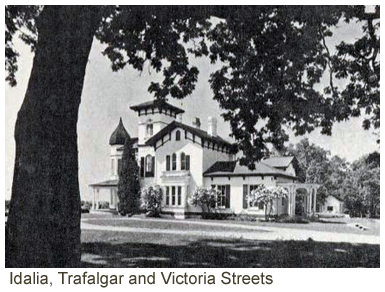
Port Hope was obviously prospering during the 1850s and '60s, for other villas were rising at that time. The Port Hope Guide of 25 September 1858 described The Cone at 115 Dorset Street as one which 'promises to be, when completed, a veritable Gem.' This was the home of Thomas Curtis Clark, a merchant and associate engineer for the Port Hope, Lindsay and Beaverton Railway. His wife was Elias Smith's daughter Susan. Twenty years later
J G 'Yankee' Williams, who bought the house in 1874, added the eastern half, containing a dining room and bedrooms. He was called 'Yankee' Williams to distinguish him from the local Williams family.
North of Port Hope, in an amazingly sylvan setting considering its proximity to Highway 401, is a mill and a small house that belonged to the Molson family. The property was granted to Jonathan Walton in 1804, sold by him to Zaccheus Burnham of Cobourg in 1817, and then (with one owner in between) to Horace Perry in 1831. In his will Perry mentioned a 'dwelling house and out buildings'; it seems likely that this trim storey-and-a-half frame house was the dwelling to which he referred. Certainly its architectural detailing relates to the period.
In 1855 Thomas Molson bought the site for £337 and the mill was probably built shortly afterward. Molson had broken away from his family's Montreal brewing interests
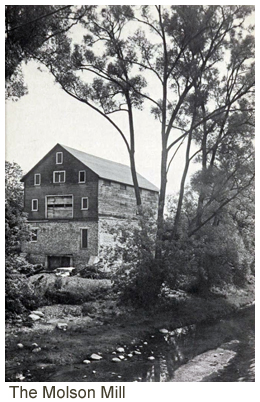 and had established himself in Kingston and Port Hope. The distillery he opened was one of several (eight at one point) that produced Port Hope whiskey, a local product made with the waters of the Ganaraska that was famous in Europe for much of the nineteenth century. Molson's resident manager was Robert Orr, and it was probably he who occupied the mill house. In a history of the Molsons, Merrill Denison reported that correspondence with Orr indicated holdings in Port Hope that included one, and probably two distilleries, a brewery, saw, flour, and grist mills, at least one stave factory, one or more warehouses, and what was then the best wharf in the harbour.
At the west end of Port Hope stands the home of John Brand, a farmer. He built the red brick house at 350 Lakeshore Road sometime between 1855 and 1865.
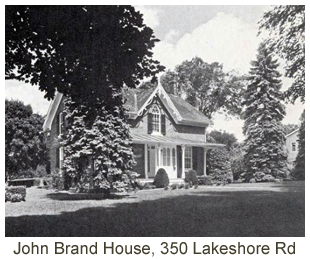 It is a handsome building, exemplifying those characteristics that made this style so popular in Ontario. The peaked gable, graceful cathedral window, and delicate bargeboard are beautifully proportioned and executed. The property (lot 10, concession 1, Hope
Township) was purchased from John Shuter Smith, Brand's neighbour to the west, and the house was built for Brand by his father, Daniel Brand, whose homestead was further along the Lakeshore Road. The house remains today in its original condition. To some extent this may be due to the fact that John Brand's wife was a meticulous housekeeper, so much so, it is said, that few of the family or friends were ever invited inside lest they disturb its perfection. Subsequent owners have treasured its happy state.
It is a handsome building, exemplifying those characteristics that made this style so popular in Ontario. The peaked gable, graceful cathedral window, and delicate bargeboard are beautifully proportioned and executed. The property (lot 10, concession 1, Hope
Township) was purchased from John Shuter Smith, Brand's neighbour to the west, and the house was built for Brand by his father, Daniel Brand, whose homestead was further along the Lakeshore Road. The house remains today in its original condition. To some extent this may be due to the fact that John Brand's wife was a meticulous housekeeper, so much so, it is said, that few of the family or friends were ever invited inside lest they disturb its perfection. Subsequent owners have treasured its happy state.
Next door, at 366 Lakeshore Road, is Wildwood, the home of John Shuter Smith. He was a grandson of Elias Smith and served as a Member of Parliament from 1857 to 1864.
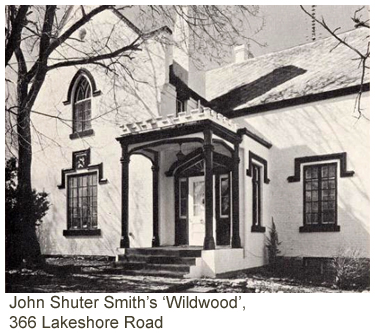 He is said to have addressed his constituents from a balcony on the east side of the house. In the early part of this century, racing stables and a track were located at the rear. There is a sad family story about John Shuter's wife, Josephine Jones. After the death of her husband, Josephine married a German count and left with him to live in his castle in Europe. After some years abroad, during which time she had been receiving interest from her inheritance, she wrote demanding the principal. Her brothers-in-law became suspicious and set out to investigate. They found the count's castle, and Josephine incarcerated within it. After that, Josephine went home to Port Hope. Josephine's great-niece, Phyllis M. Smith, told this story in her memoirs (kept in Port Hope). She added a detail which might have warned the family. The count had given his bride, as a wedding present, a gold locket with his family arms and his initials both set into it in pearls. 'Josephine,' remarked Phyllis Smith, 'must have been horrified on receiving the bill for it.'
West on the Lakeshore Road, on lot 15, concession 1, Hope, is a two-storey brick house that belonged to Daniel Brand. The Crown grant for the land was a late one, issued jointly in 1842 and 1845 to Brand and his father-in-law. Daniel Brand was born in 1792 in Ipswich, England. After settling in Canada, he made numerous trips back to England in connection with an inheritance, the receipt of which undoubtedly made his life as a farmer in Canada more comfortable. The brick on the Brand house, which covers the earlier frame structure, was laid by Richard Trick, the mason on Ridout Street.
The Lakeshore Road from Port Hope to Newcastle can rightly be called a heritage highway, for it was completed in 1800, making it one of the first roads in Upper Canada. During the War of 1812 it was used as a military road. For many years after, cannon balls were found in the adjacent fields where they had been stored. An older resident in the area recalls a tale passed down through generations, of a small boy who never forgot the sight of the sun glinting on the soldiers' bayonets.
During the war the authorities concluded that this road, situated so close to the lake, was vulnerable to attack. A new road was built to the north, on the third concession, and was opened in 1817.
To the west of Port Hope, the Lakeshore Road passes through Port Britain, a community that was, in mid-century, equal in size and prosperity to neighbouring Port Hope. Today only a handful of houses remain. Port Britain's prosperity was the result of the energy of one family, that of Samuel Marsh and his descendants. At its peak, Port Britain exported over two hundred masts per year for the Royal Navy, and sent lumber across the sea on the sailings ships of the Marsh Line.
The history of Port Britain begins in Manchester, Vermont, where William Marsh chose to remain loyal to the Crown and eventually left with his family to take up land in Canada. William received amnesty after the war and returned to Vermont, where he is said to have searched in vain for the family silver and pewter his wife had hidden from the rebels in their farm pond: the pond had a quicksand bottom. His sons remained in Canada.
According to another family story, William's sons were passing through Carrying Place on the Bay of Quinte when they saw some young ladies skating on a pond. Samuel Marsh took one look at young Jane Ostium, pulled his horse to a halt, and announced that he had just seen his future wife. In February of that winter they were married, and a year later moved to Port Britain where they built a log house in 17%. Samuel Marsh died of ague (a malarial fever) in 1813, leaving nine children, the oldest of whom was William, then aged sixteen.
 It was William who created the vast lumbering and shipping business.
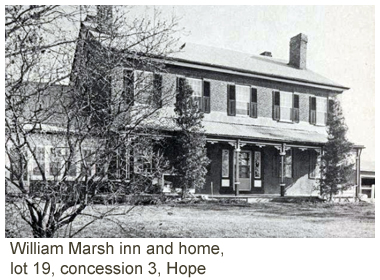
On the north side of Highway 2, west of Welcome (on lot 19, concession 3, Hope), stands the house that William built in 1825. It was associated with a stage coach inn; guests were housed in an east wing that contained a tavern, driving shed, stables, and a ballroom. The house had eight large rooms, each with a fireplace. A deer park was located on the property.
A strange request from William's sister, Susannah, prompted the building of a Marsh family vault that still can be seen near Lake Ontario. Susannah wanted a marble tomb, and on her death she became the twenty-seventh and last member to be placed inside it.
Just east of the creek in Port Britain (lot 20, concession 1) is a sturdy stone house that was built for William's brother Robert. Both the house and barn were built before 1850. The house seems to have been planned in a somewhat haphazard fashion, for no one window is located directly over another. The most interesting feature of this small building is a signature scratched carefully in the glass:
'R B Marsh, 1856.'
Set well back from the road, on the west side of the creek (lot 21, concession 1, Hope) is the home of Joseph Major, a miller. The house, stucco over frame, was built shortly before 1848. The community then
 supported more than three hundred and fifty people, including one wagonmaker, two blacksmiths, two coopers, two shopkeepers, two builders, a stonemason, contractor, station master, harbourmaster, postmaster, teacher, veterinarian, innkeeper, fishermen, and a tailor, not to speak of those involved in William Marsh's shipping and lumbering business. Today there is little to indicate that Port Britain was once such an active and prosperous village. The Marsh family, however, is still represented, for the miller's house is owned by a direct descendant of Samuel Marsh, keeping ties with the community that go back nearly two hundred years.
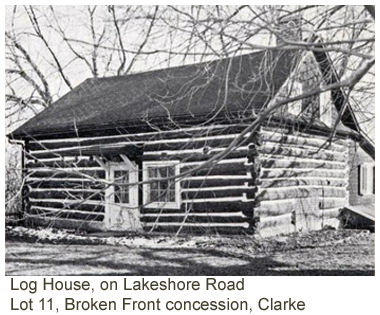
Tanglewood Farms lies further west along the Lakeshore Road on lot 11, Broken Front concession, Clarke. There, standing by the shore of the lake, is a small log house looking just as it did one hundred and fifty years ago. It was built on land that belonged to King's College until 1850 but the house was certainly there long before that. Some details of the construction suggest a date in the 1820s, and a small scrap of wallpaper found in one of the bedrooms has a pattern used extensively in New England at that time. One architectural historian feels that this fine log building may well have been constructed by shipwrights. Inside, a narrow staircase winds up behind the massive fireplace to two small bedrooms. The doors, which retain their original hardware, are made of solid pine slabs, twenty-six inches wide.
supported more than three hundred and fifty people, including one wagonmaker, two blacksmiths, two coopers, two shopkeepers, two builders, a stonemason, contractor, station master, harbourmaster, postmaster, teacher, veterinarian, innkeeper, fishermen, and a tailor, not to speak of those involved in William Marsh's shipping and lumbering business. Today there is little to indicate that Port Britain was once such an active and prosperous village. The Marsh family, however, is still represented, for the miller's house is owned by a direct descendant of Samuel Marsh, keeping ties with the community that go back nearly two hundred years.
Tanglewood Farms lies further west along the Lakeshore Road on lot 11, Broken Front concession, Clarke. There, standing by the shore of the lake, is a small log house looking just as it did one hundred and fifty years ago. It was built on land that belonged to King's College until 1850 but the house was certainly there long before that. Some details of the construction suggest a date in the 1820s, and a small scrap of wallpaper found in one of the bedrooms has a pattern used extensively in New England at that time. One architectural historian feels that this fine log building may well have been constructed by shipwrights. Inside, a narrow staircase winds up behind the massive fireplace to two small bedrooms. The doors, which retain their original hardware, are made of solid pine slabs, twenty-six inches wide.
In 1855, Andrew Thomas purchased the house and land from the University of Toronto (the successor to King's College) and farmed it for about forty years. His name last appears on the title in 1896. Eleven years later, William Thomas (perhaps a son) sold the property to Alfred and Percy Brown. For a long time after this, the small log house was used as a sheep barn. Recent owners have lovingly and authentically restored it.
Use the form below to comment on this article. A name is required, optional Email addresses will not be revealed.